
Decoding Flatiron’s Trader Joe’s
A Therapy Session Disguised as a Grocery Run

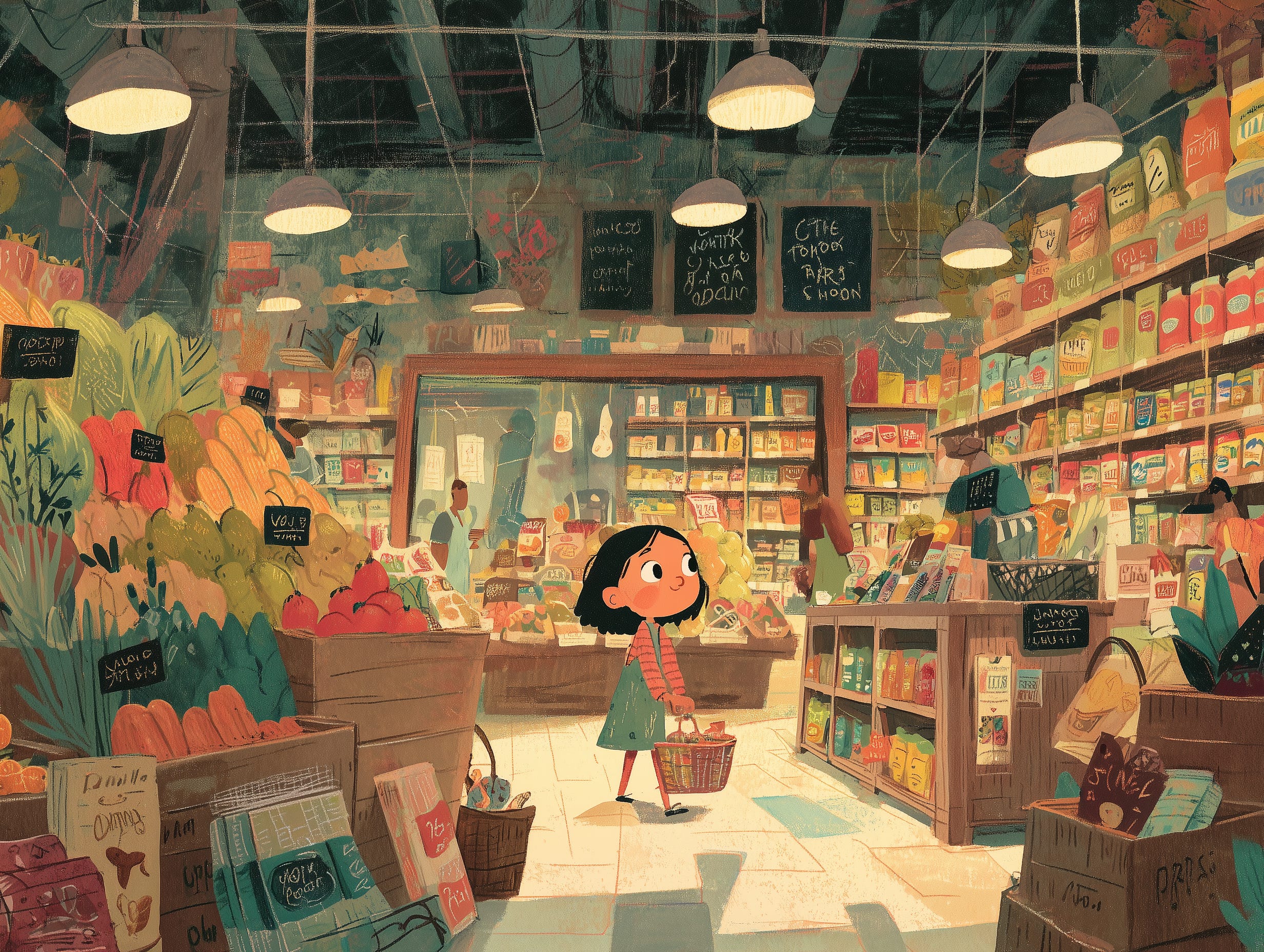
Some people journal. Some people meditate. Some people run.
And some people—quietly, like me—go grocery shopping.
Not for the milk. Not for carrots. But for the brief comfort of a solvable task: enter, choose, pay, leave. In 2026, that kind of small closure can feel like therapy—because they produce an ending in a city full of open tabs.
New York, of course, makes even closure feel competitive. The city is cognitively loud. It asks you to make hundreds of micro-decisions before lunch: how fast to walk through scaffolding tunnels, whether to pause for a saxophonist at Union Square, when to stop without becoming an obstacle. Even leisure arrives scheduled.
So when a place reduces decision fatigue—when it makes a crowd feel readable—it registers as care, even when it’s selling eggs.
The Flatiron Trader Joe’s makes this argument unusually easy. It sits inside a former Ladies’ Mile department-store building, constructed in 1901–1902 for Adams Dry Goods, built to make shopping feel like an event. A century later, “shopping as an event” has been replaced by something rarer: shopping as relief—the unlikely outcome of a heritage building hosting a brand that makes an ordinary errand briefly navigable in a city designed to keep you braced.
Even the Flatiron location reveals its choreography on Google Street View - here, have a look.
Trader Joe’s, of course, does some of this everywhere. But here, the contrast is sharper. In a neighbourhood where retail identities constantly turn over, this store has stayed—and in 2025, it renewed its lease at 675 Avenue of the Americas. Stability is an underrated amenity in New York.
You could call this a dramatic reading of a grocery store. Or you could call it a case study in how contemporary urban interiors quietly take on civic work: absorbing overstimulation, editing choice and turning an errand into something that feels, for a few minutes, manageable.
Trader Joe’s as an urban stabilizer
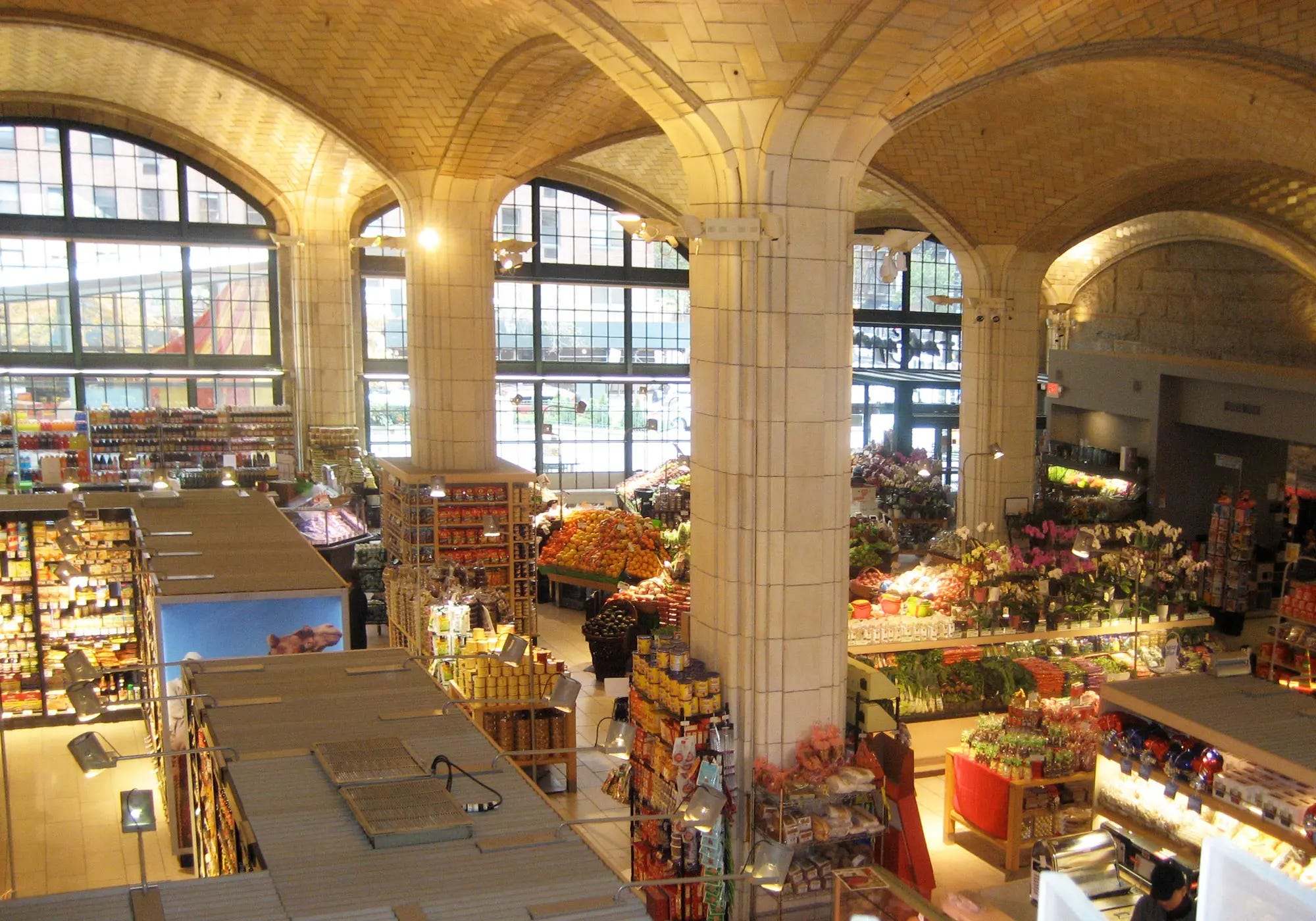
Photo by missvancamp on Flickr (6sqft)
If you grew up in India, you understand this instinctively. There are places that are not “home” and not “work,” but still feel like emotional infrastructure: the reliable chaos of a sabzi mandi, the comfort of a neighborhood kirana where the shopkeeper knows your “usual,” or the sticky familiarity of Nature’s Basket, Big Bazaar and premium urban supermarkets. They all carry a quiet promise: you will find what you need, the way you expect to find it.
In New York, Trader Joe’s plays a similar role, but with a twist. It behaves like a neighborhood store scaled up into a national brand—friendly, contained, and oddly human instead of a high-gloss grocery experience of premium chains.
No coupons. No loyalty points. No over-engineered personalization. Very little digital performance. In 2026, that restraint reads less like a refusal to modernize and more like a rare design decision: a place that does not demand your attention the way everything else does.
Overstimulation, curated “peaceful chaos” as a design strategy
Step inside almost any Trader Joe’s and you’ll find a paradox: crowding without hostility.
The store stays packed, but the experience doesn’t always feel cumbersome. This isn’t a big-box supermarket where you disappear into endless aisles. It’s smaller, denser, and compressed—unavoidable in New York, but also quietly strategic. The space forces you into proximity, yet it avoids the humiliation of pure congestion by staying legible. You can tell where you are, and roughly where you need to go.
In other words: the chaos has a map. Part of that is the footprint. Part of it is assortment. Trader Joe’s doesn’t make you walk past five versions of the same thing. The edit is the design. Fewer choices mean fewer dead ends—physical and mental—and fewer moments where you stall in front of a shelf performing indecision.
This is where Trader Joe’s differs from many contemporary retail interiors that rely on sleek minimalism and endless variety as a status symbol. Whole Foods can feel like an airport lounge for groceries—beautiful, aspirational, and faintly exhausting. Trader Joe’s is calmer in a different way: not because it’s quiet, but because it’s edited.
And then there’s the handwritten placards and signage. Trader Joe’s doesn’t speak in corporate typography. It speaks in human handwriting. The signs have a local looseness—less brand guideline, more crew personality—and that matters more than it should. They don’t just sell. They soften. They turn price tags into small conversations, and a chain store into something that reads, briefly, like a neighborhood.
It also sneaks in something most grocery stores have forgotten how to do without making it feel like marketing: it gives you permission to pause. When the tasting station is active, people hover, sample, exchange small talk, or simply stand still for a minute without looking lost. In a city built on movement, that small sanctioned stop feels almost radical.
And in a city engineered to keep you alert, even a small drop in cognitive load can feel like mercy.
Old New York bones, new New York choreography
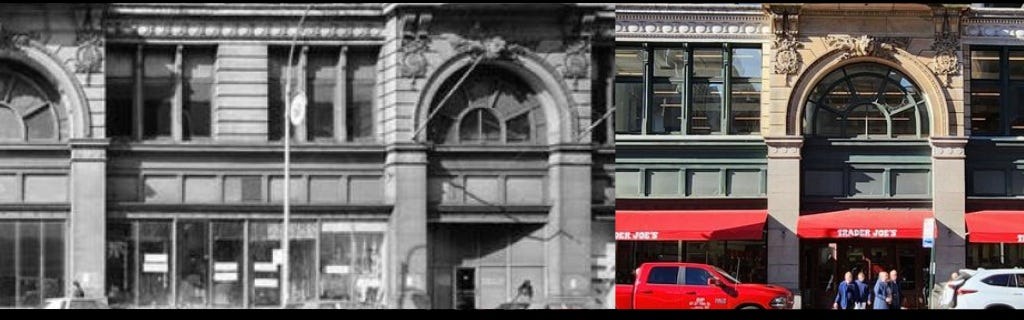
This is one of the stranger alignments in contemporary retail: a brand known for handwritten signs, warm wood tones, and cheerful informality occupying a building language built to communicate permanence. Corinthian columns frame an entry that once promised serious shopping. The arched windows act like civic apertures—letting the street and the store watch each other in real time.
It’s a spatial mismatch that works, precisely because it creates contrast. The building supplies the authority; the store supplies the looseness. In a city that often forces people to perform confidence just to move through it, Trader Joe’s offers a space where you can drop your posture.
A Beaux-Arts envelope may not have been built for Mandarin Orange Chicken, but it does something useful here: it gives an everyday purchase a sense of occasion. The building still holds traces of its original department-store ambition—an interior courtyard rising toward a skylight—now hosting a very different kind of everyday New York ritual.
The mezzanine: a missed civic opportunity
And yet—this branch has an architectural flaw that is hard to ignore.
The store’s mezzanine level remains closed to the public. Staff members describe it as storage, while recalling that a previous tenant, Barnes & Noble, used it as a sit-and-stay zone—which makes its current state feel especially odd: an elevated platform inside one of the city’s most crowded grocery stores, sitting unused like a sealed balcony in a packed theatre.
In a city where square footage is treated as religion, this kind of spatial underuse feels almost offensive.
But the mezzanine is more than inefficiency. It’s a missed opportunity for something New York is quietly starving for: spaces that allow people to pause without being forced to spend more.
Imagine if Trader Joe’s used the mezzanine as a micro “public room”—minimal seating, a community bulletin board, or simply a place to sit and eat a snack without apology. Not a café chain. Not a branded lounge. Just a neutral perch above the retail theater, where shopping could turn into lingering.
In India, we understand the value of such perches: the chai tapri stool, the metro station ledge, the bakery corner table, the “standing and talking” space that turns into community. New York needs those too—especially now, when loneliness has become a design brief no one wants to admit they’re solving.
Trader Joe’s could do it. Few brands are better positioned to try because Trader Joe’s already sells something beyond products: it sells familiarity.
References
https://flatironnomad.nyc/history/675-sixth-avenue/